

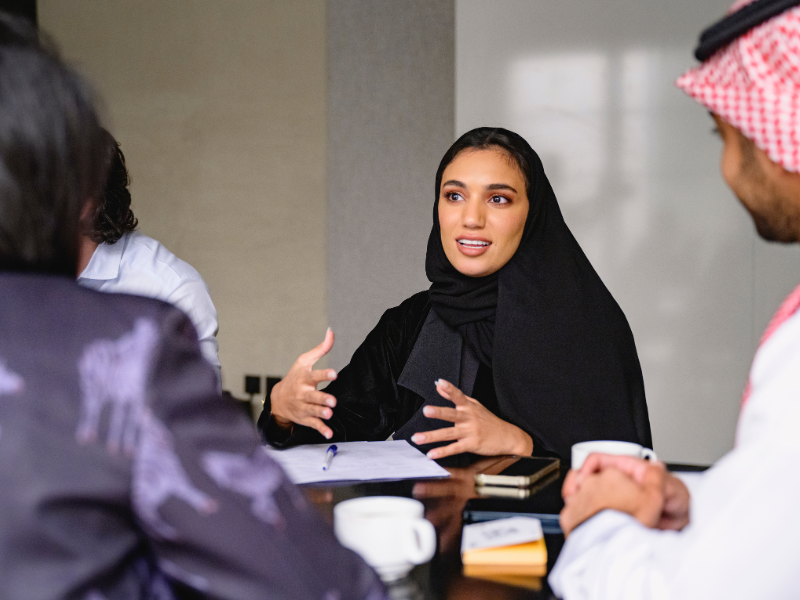
Step into almost any office in Dubai or Abu Dhabi today and you’ll notice something that simply didn’t exist a generation ago: leadership tables that are genuinely mixed by gender, nationality, and generation. A UAE national director might report to an expat VP; a young Emirati woman might manage a team twice her age; a Saudi-born team lead might coordinate with colleagues across four time zones before lunch. This is the modern Gulf workplace, and it’s exactly the kind of environment where old-school “management advice” runs out of road fast.
That’s the real difference between advice and professional coaching. Advice hands someone an answer. Professional coaching helps a leader build the judgment to find their own answers, repeatedly, under pressure, in rooms that look nothing like the ones their training was designed for. For HR and L&D leaders across the UAE and Saudi Arabia, understanding this distinction isn’t academic. It determines whether a coaching investment produces a one-time fix or a leader who keeps improving long after the engagement ends.
Why Advice Runs Out and Coaching Doesn’t
Most leadership advice is generic by design. A consultant or a well-meaning senior colleague tells a manager what worked for them, in their context, at their company. It might land once. It rarely holds up when the manager faces a genuinely new situation, such as leading a mixed-gender project team through a sensitive client negotiation, or managing a Gen Z hire who expects daily feedback while sitting next to a veteran employee who expects none at all.
Coaching for leadership works differently. A trained coach doesn’t supply the script. Instead, they ask the questions that help a leader notice their own patterns, biases, and blind spots, then build the skill to adapt in real time. This is why coaching outcomes tend to compound. A leader who learns how to run a difficult conversation once, with support, is far more likely to handle the next five difficult conversations alone.
The data supports this. According to the ICF and PwC Global Coaching Client Study (2024), 87% of coaching clients across 64 countries reported a positive return on investment, with a median return of five to seven times the cost of the engagement. That isn’t a one-off improvement; it’s evidence of a skill that keeps paying dividends.
The Regional Challenge: Diverse Teams, Mixed-Gender Leadership, and the Fear of Speaking Up
Three challenges come up again and again in conversations with HR and L&D teams across the region, and a training deck rarely solves any of them.
Mixed-gender teams without a shared leadership playbook. The UAE has made real, measurable progress here. The UAE Gender Balance Council has mandated that private-sector companies place women in 30% of leadership positions, and government data already shows women holding a meaningful and growing share of leadership roles across sectors. But representation and readiness are two different things. Many managers, male and female, have never been trained on how to lead a genuinely mixed-gender team: how to run meetings where everyone’s voice carries equal weight, how to give feedback across cultural and gender lines without it landing as too harsh or too vague, how to sponsor talent without playing favorites.
The reluctance to speak up. In many Gulf organizations, especially those with steep hierarchies or a strong expat-national dynamic, junior staff and even mid-level managers hesitate to challenge a senior leader’s idea in the room. This isn’t a personality flaw; it’s a rational response to a culture where disagreement has historically carried career risk. McKinsey’s research on psychological safety found that 89% of employees believe psychological safety at work is essential, and that it’s consistently one of the strongest predictors of team performance, innovation, and better decision-making. Leaders who never learn how to actively invite dissent are leaving performance on the table, whether they realize it or not.
Multitasking without a system. Regional leaders are often pulled across multiple business units, multiple languages, and multiple stakeholder groups in a single day. Without a coach helping them build prioritization habits and delegation skills, “doing everything” becomes the default, and burnout follows close behind.
This is precisely where leadership coaching earns its place on the HR agenda: not as a perk, but as a practical answer to problems a policy memo can’t fix on its own.
How Coaching Actually Creates Change
A good coaching engagement follows a rhythm, not a script. It typically starts with a real conversation about what “better” looks like for that specific leader, on their specific team. From there, most engagements move through a few consistent stages.
- Diagnosis. The coach and leader identify actual behavioral patterns, often using 360-degree feedback, rather than relying on assumptions about what needs to change.
- Practice in low-stakes moments. Leaders rehearse harder conversations, whether that’s inviting a quieter team member to speak first in a meeting or giving direct feedback to a peer, before trying it in a high-stakes setting.
- Real-world application. The leader tries the new behavior at work between sessions and brings back what happened.
- Reinforcement. The coach helps the leader adjust, building consistency so the change survives beyond the coaching engagement itself.
This is also where a modern coaching platform makes a genuine difference for HR teams managing coaching at scale. Instead of relying on a single external consultant with limited capacity, an organization can match leaders across Dubai, Riyadh, and Abu Dhabi offices with vetted coaches, track progress against clear goals, and run everything through virtual coaching sessions that fit around a leader’s actual schedule. For a regional business with people split across cities or even countries, virtual coaching isn’t a compromise; it’s often the only realistic way to deliver consistent, confidential coaching at the pace the business needs.

Outcomes to Expect
Organizations that invest in structured leadership coaching should expect to see change across a few concrete areas, typically within three to six months of consistent sessions.
- More balanced participation in meetings. Leaders learn specific techniques to draw out quieter voices, which matters enormously in mixed-gender and multicultural teams where some people naturally hold back.
- Fewer avoidable escalations. When leaders get comfortable having direct conversations earlier, problems get addressed before they turn into formal HR cases.
- Stronger delegation and reduced burnout risk. Leaders coached on prioritization typically report handing off more work appropriately instead of absorbing everything themselves.
- Higher retention among high-potential talent, particularly women and younger employees, who consistently report that having a visible, supportive leader is one of the top reasons they stay.
- Better succession readiness. Coaching builds the judgment and self-awareness that can’t be taught in a single workshop, which is exactly what boards and C-suites look for when they assess bench strength.
None of this happens overnight, and any coaching provider who promises instant transformation should be treated with some skepticism. What organizations can reasonably expect is steady, visible progress that shows up in how meetings run, how feedback gets given, and how confidently a leader handles the next unexpected problem.
FAQ
Is professional coaching only for underperforming leaders? No. Some of the strongest cases for coaching come from high-potential leaders being prepared for a bigger role, not leaders who are struggling. Coaching is development, not remediation.
How is coaching different from mentoring? A mentor typically shares their own experience and advice from a similar role. A coach focuses on helping the leader develop their own thinking and decision-making, regardless of whether the coach has direct experience in that specific industry.
Can virtual coaching really replace in-person sessions? For most leadership development goals, yes. Virtual coaching removes travel time, makes scheduling across multiple offices far easier, and studies on remote coaching engagements show comparable outcomes to in-person work when the platform and coach matching are done well.
How do we measure ROI on a coaching program? Track a mix of qualitative and quantitative signals: 360-degree feedback shifts, retention rates among coached leaders, engagement survey scores, and manager-reported behavior change. Given that coaching engagements report a median ROI of five to seven times the investment, most HR teams find the business case straightforward once they track it properly.
What does a typical engagement length look like? Most effective leadership coaching engagements run for four to nine months, with sessions every two to three weeks. Shorter engagements tend to produce insight without enough time to build lasting habits.
Build Leaders Who Can Handle What Advice Can’t
The UAE’s leadership landscape is more diverse, more mixed-gender, and more demanding than it’s ever been. That’s a genuine advantage for organizations that build leaders capable of navigating it well, and a real risk for those that don’t. Advice can get a leader through today’s problem. Coaching builds the leader who can handle tomorrow’s.
If your organization is ready to move past generic leadership training and invest in coaching that actually changes behavior, we’d like to talk. Book a discovery call to discuss your team’s specific challenges, or find a coach matched to your leaders’ goals and industry.